
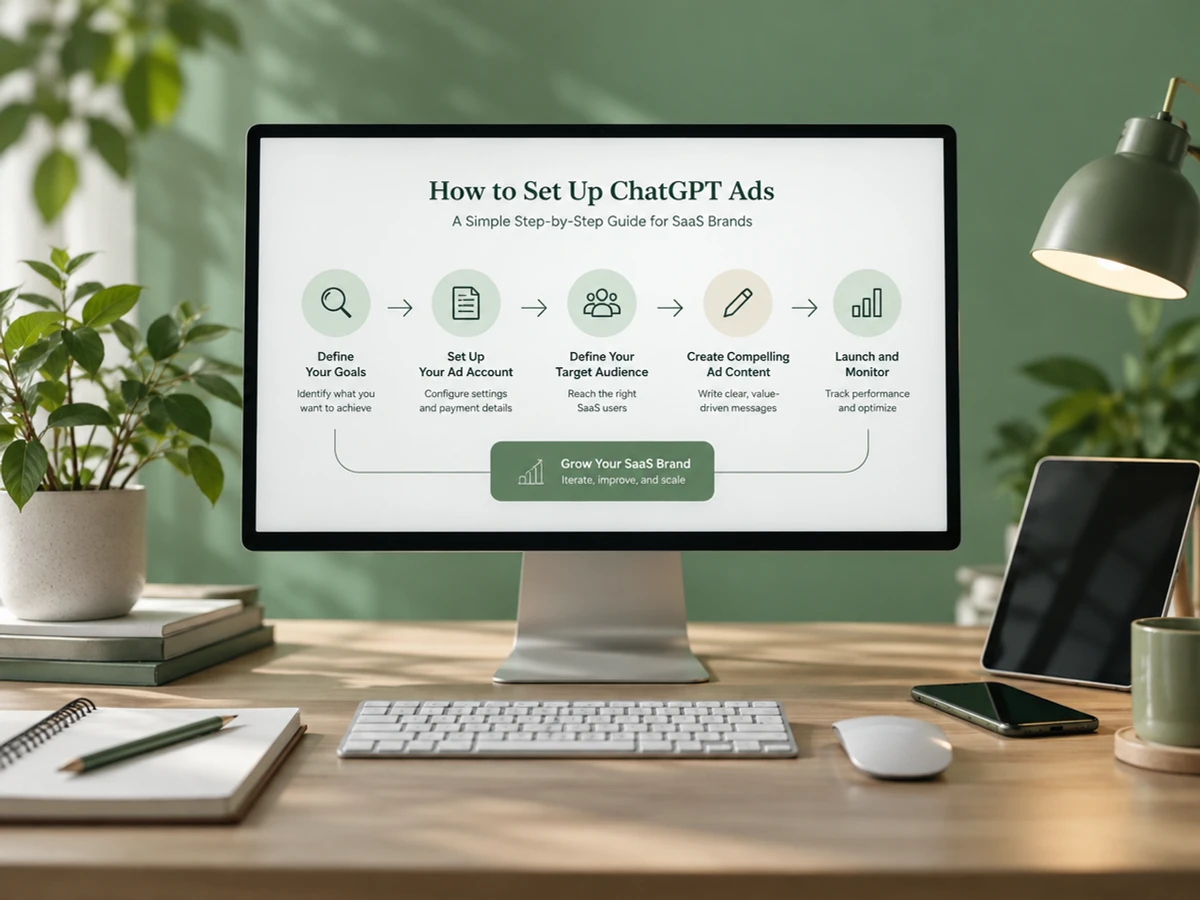
how to set up ChatGPT ads for a SaaS brand step by step in 2026 | October 31, 2026 | Indexly Editorial Team | 2-3 hours setup, 4-6 weeks optimization | Beginner
What You'll Learn
This guide walks you through setting up ChatGPT ads for a SaaS brand in 2026, from eligibility and account setup in OpenAI's self-serve Ads Manager at ads.openai.com through targeting, creative, conversion tracking, and optimization. Any U.S. SaaS company can build a campaign without an enterprise sales relationship.
- How to register and activate a ChatGPT Ads Manager account in 2026
- How context-hint targeting replaces keywords and demographics on this platform
- How to launch a CPM or CPC campaign and attach conversion tracking
- How to read early results and decide whether to scale spend
You'll need a live SaaS product with a trial or demo funnel, a U.S.-based business entity (or operations in an eligible market), and a budget of at least a few hundred dollars for a learning phase.
Why ChatGPT Ads Matter for SaaS Brands in 2026
ChatGPT advertising became a real channel faster than most ad platforms ever have. OpenAI's ads pilot passed $100 million in annualized revenue within two months of its January 2026 launch. By October, the business had reportedly reached a one billion dollar annualized revenue run rate in under two hundred days. SaaS brands are a big part of what's driving that growth.
According to Similarweb's ChatGPT Ad Intelligence tracking, eight of the top 10 advertisers by global impression share are B2B SaaS or productivity brands. Active advertisers also grew 46% in a single week after OpenAI lowered its spend threshold. SaaS buyers are already seeing sponsored answers when they ask ChatGPT which tools to use.
Here's the catch: a lot of your buyers may never see these ads. A survey cited by Omni Lab Consulting found that 74% of SaaS and tech marketers polled were on paid ChatGPT plans, and those plans are entirely ad-free. That's why organic AI visibility (how your brand shows up in ChatGPT's unpaid answers) matters as much as paid spend. Tools like Indexly track brand citations across both paid and organic AI surfaces.
The Process at a Glance
| Step | Action | Time | Outcome |
|---|---|---|---|
| 1 | Confirm eligibility and set up Ads Manager | 20-30 minutes | Active OpenAI advertiser account |
| 2 | Define context hints and campaign objective | 30-45 minutes | Targeting brief ready for creative |
| 3 | Build ad creative and launch campaign | 45-60 minutes | First live campaign serving impressions |
| 4 | Connect conversion tracking and attribution | 30-45 minutes | Pixel firing, trials tied to spend |
| 5 | Monitor performance and optimize weekly | Ongoing, 30 min/week | Improved CPA and AI share of voice |
Plan on roughly 2-3 hours to get your first campaign live, then 4-6 weeks of optimization before drawing firm conclusions.
Step 1: Confirm Eligibility and Set Up Your Ads Manager Account
Approval can be slower than you'd expect, so start here to keep the rest of the project from stalling.
What You're Doing
Confirm that your SaaS brand can advertise in the markets and to the audiences ChatGPT currently supports, then create your advertiser account.
How to Do It
- Check that your business operates in an eligible region. OpenAI launched ads in the U.S. in February 2026 and has since expanded to Canada, Australia, New Zealand, the UK, Mexico, Brazil, Japan, and South Korea.
- Go to ads.openai.com and register your business. OpenAI opened its self-serve Ads Manager to all U.S. businesses on May 5, 2026, with no minimum spend requirement.
- Complete business verification and payment setup. For your first campaign, choose between CPM (cost-per-mille, or cost per thousand impressions) and CPC (cost-per-click) billing.
- Read OpenAI's advertising policies. Advertisers must comply with applicable laws, and OpenAI describes how it screens, monitors, and enforces those rules.
Best Practices
- Register early, even if you aren't ready to spend. Approval can take longer than the campaign build.
- Only Free and ChatGPT Go ($8/month) users see ads. Your reachable audience is narrower than total ChatGPT usage suggests.
Common Mistakes
It's easy to assume your entire target audience can be reached. But subscribers on Plus, Pro, Team, Business, Enterprise, and Edu plans see no ads at all. If your ideal customers are power users on paid tiers, treat this channel as top-of-funnel awareness, not a direct-response engine.
What Done Looks Like
You have an approved, funded Ads Manager account and a realistic picture of how much of your audience paid ChatGPT placements can reach.
Key Takeaway: Only Free and Go tier users see ads, so confirm eligibility and set expectations before spending. For a more detailed walkthrough, see How to Create ChatGPT Ads: Complete Step-by- ....
Step 2: Define Your Context Hints and Campaign Objective
Most teams copy their Google Ads keyword list and wonder why nothing lands. ChatGPT works differently, so your targeting has to as well.
What You're Doing
ChatGPT ads don't use keyword bidding or demographic targeting the way Google and LinkedIn do. Your job is to tell OpenAI's system what kinds of conversations your ad fits into.
How to Do It
- Choose a campaign objective. As of mid-2026, ChatGPT Ads supports Views and Clicks as objectives, while Conversions is still in development, so set KPIs accordingly.
- Write context hints, which are descriptive phrases or sentences that describe the products, categories, and user intents your ad should appear alongside. They replace keyword and demographic targeting. ChatGPT ads don't use keyword targeting or demographic segments. Instead, OpenAI's auction weighs relevance signals, and context hint quality is one of them.
- Understand how the system picks ads. An OpenAI engineering post describes an orchestrator model that tracks conversations and infers commercial needs in real time. Your hints should sound like how a buyer actually talks, not like a rigid keyword list.
- Save research time with a platform like Indexly. Its prompt tracking and citation gap analysis surface the questions SaaS buyers ask AI engines about your category. Turn those questions into context hints and ad copy.
Example
| Buyer intent signal | Weak context hint | Strong context hint |
|---|---|---|
| Comparing project management tools | "project management software" | "best project management tool for remote teams under 20 people" |
| Evaluating CRM pricing | "CRM pricing" | "affordable CRM alternatives with free trial for small sales teams" |
What Done Looks Like
You have a written targeting brief with specific, conversational context hints and a realistic objective (Views or Clicks), not a keyword list copied from your search account.
Key Takeaway: Write context hints that sound like real buyer questions. The platform rewards conversational relevance over keyword matches. For a more detailed walkthrough, see 7 ChatGPT Ads Strategies Every Business Should .... For related guidance, see How To Choose The Best AI Search Visibility Tracking Tool Step By Step Guide.
Step 3: Build Your Ad Creative and Launch the Campaign
Your hints become a sponsored card that appears right under a real answer, so the copy has to earn its place.
What You're Doing
This step produces a live, sponsored card that appears beneath ChatGPT's generated answers.
How to Do It
- Write short ad copy with a clear call to action. Ads appear in a labeled "Sponsored" card below the response and stay visually and structurally separate from ChatGPT's answer.
- Set your bid. ChatGPT ads run at a $60 default CPM with a recommended $3-5 CPC starting bid, through a relevance-weighted second-price auction.
- For SaaS, lead with pricing transparency and specifics. SaaS companies using conversational advertising are putting pricing up front and adding interactive cost calculators in the ad experience.
- Launch with a modest learning budget kept separate from your existing paid search and social spend. The goal is campaign intelligence, not immediate ROAS.
- If you manage multiple campaigns, Indexly's Ads Agent can automate creative. It generates and refreshes context-hint-aligned creative variants as your GEO content calendar evolves.
Best Practices
- Keep creative honest and specific. Vague SaaS positioning falls flat in a conversational format. A direct answer to the question the buyer just asked usually performs best.
- Plan for a multi-week learning phase before judging results, since the auction and delivery systems are still maturing.
What Done Looks Like
Your campaign is live and serving impressions, and spend is tracking against a dedicated test budget, not your core demand-gen numbers.
Key Takeaway: Launch with specific, honest copy and a small, dedicated budget. Real data beats guessing. For related guidance, see AI Search Visibility Tracking Best Practices Step By Step Guide.
Step 4: Connect Conversion Tracking and Attribution
If you don't track conversions from day one, you won't know whether ChatGPT clicks turn into trials, demos, or signups. On a new platform, that gap hurts more.
What You're Doing
You're making sure every ChatGPT ad click can be followed to a signup or demo request.
How to Do It
- Install the OpenAI pixel or connect through the Conversions API on your signup and demo-request pages. The pixel is a snippet of code that tracks actions like signups that come from ChatGPT ads. The Conversions API sends data server to server, which tends to be more reliable.
- Know the current limits. CPA bidding is only in pilot testing, and access to it depends on having conversion tracking active through the OpenAI pixel or Conversions API. Pricing hasn't been confirmed yet.
- Treat early campaigns as upper-funnel. ChatGPT ads often start a buyer's journey that finishes through other touchpoints, so pair pixel data with your CRM's multi-touch attribution.
- Add AI traffic analytics beyond the ad click. Indexly's integrated analytics track AI engine sessions and feed a lead dashboard, helping you connect paid exposure to the AI-driven organic sessions and citations that follow.
Common Mistakes
Mistake 1: Expecting last-click data that matches Google Ads. Fix: Report on assisted conversions and pipeline influence until native Conversions objectives mature.
Mistake 2: Skipping the pixel because Conversions bidding isn't fully available. Fix: Install it anyway so historical data is ready when CPA bidding leaves pilot.
What Done Looks Like
Every trial signup or demo request from a ChatGPT ad click is logged and attributable, even if automated conversion optimization isn't available yet.
Key Takeaway: Set up conversion tracking now, and use multi-touch attribution to see the upper-funnel impact of your ads.
Step 5: Monitor Performance and Optimize for AI Share of Voice
Paid clicks tell only part of the story. Winning SaaS brands also watch how often they appear in unpaid answers, because that's where buyers often make up their minds.
What You're Doing
You're tracking paid results and how often your brand gets mentioned, cited, or recommended in unpaid AI answers.
How to Do It
- Review CPM, CPC, and click-through data every week for the first month. Delivery will keep shifting as OpenAI tests new formats, including a Sponsored Agent pilot, where clicking an ad opens a chat with the advertiser's own AI agent inside ChatGPT instead of sending people to a website.
- Compare your paid impression share with competitors. Use Indexly to check your AI visibility score, citation share, and brand sentiment against competitors across ChatGPT, Google AI Overviews, Gemini, Perplexity, and Microsoft Copilot. AI Share of Voice is how often your brand is mentioned or recommended in unpaid AI answers compared with competitors.
- Feed citation gaps back into your content. Indexly's content agents use those gaps to shape AI-generated answers through GEO-optimized articles, Reddit signals, and LinkedIn presence, reinforcing what your paid campaigns say.
- Shift budget toward the context hints and creative variants with the strongest assisted-conversion lift, and pause underperformers every two weeks.
What Done Looks Like
You have a steady weekly review routine, a rising or stable AI share of voice, and a clear record of which context hints and creative bring in the best-qualified trial signups.
Key Takeaway: Paid metrics are only half the picture. Track your overall AI share of voice and close citation gaps.
Find your AI Share of Voice
Measure your Share of Voice compared to your competitors
Measure your AI SoVWhat to Do After Launching Your ChatGPT Ads Campaign
Launching is the easy part. What comes next determines whether ChatGPT ads become a real channel or just another line item.
Phase 1 (Weeks 1-4): Validate the channel. Keep spend modest, test two or three context-hint variations, and confirm your pixel captures conversions correctly before you scale.
Phase 2 (Weeks 5-10): Scale what works. Put more budget behind the strongest objective and creative combinations, and start organic AI visibility work with tools like Indexly so paid and earned AI presence reinforce each other.
Phase 3 (Month 3 onward): Build a durable AI go-to-market motion. Treat ChatGPT Ads as one channel inside a broader AI search strategy. Track brand sentiment, citation share, and AI traffic sessions alongside traditional paid media reports. Indexly recommends a thought-leadership approach: show real use cases and publish insights on AI-driven content discovery so visibility stays steady even when ad budgets rise and fall.
Resources You'll Need
| Resource | Role | Requirement | Price |
|---|---|---|---|
| OpenAI Ads Manager | Core platform for launching and managing ChatGPT ad campaigns | Required | No minimum spend; CPM/CPC auction pricing |
| Indexly | AI search visibility, prompt tracking, citation gap analysis, and AI traffic analytics to complement paid campaigns | Recommended | Paid plans available |
| CRM with multi-touch attribution (e.g. HubSpot, Salesforce) | Connects ChatGPT ad clicks to pipeline and closed-won revenue | Required | Varies by plan |
| OpenAI Conversions API / pixel documentation | Technical setup for conversion tracking | Required | Free |
| A ChatGPT Ads specialist agency (e.g. SimpleTiger, InterTeam Marketing) | Hands-on campaign management for teams without in-house capacity | Optional | Agency retainer fees |
See also, see ChatGPT Ads in 2026: What Brands Should Know.
Common Plateaus & How to Break Through
Impressions are low despite an active campaign
Likely cause: Only Free and Go tier users see ads, and less than 20% of eligible users are shown ads on a daily basis, so delivery is deliberately conservative. Fix: Widen your context hints slightly, raise your bid toward the recommended range, and give the campaign at least two weeks before judging volume.
Clicks aren't turning into trials
Likely cause: ChatGPT ads often work as a first-touch, upper-funnel channel. Fix: Measure assisted conversions through your CRM, and make sure your landing page answers the exact question the user asked ChatGPT.
Can't reach specific job titles or named accounts
Likely cause: Targeting is less granular than LinkedIn or Google, and job title and named-account targeting aren't supported yet. Fix: Lean on context hints that mirror the language your ideal customers use when asking buying questions.
Competitors seem to dominate relevant conversations
Likely cause: Early B2B SaaS advertisers picked up outsized visibility; eight of the top 10 advertisers by impression share come from SaaS and productivity categories. Fix: Combine paid campaigns with organic AI visibility work. Track citation share in a platform like Indexly to see where competitors win unpaid mentions, then close that gap with GEO-optimized content. For more troubleshooting advice, see Everyone's hyping up ChatGPT Ads right now. But here's the ....
Conclusion
Setting up ChatGPT ads for a SaaS brand in 2026 comes down to five steps: confirm eligibility and open your Ads Manager account, write context hints instead of keyword lists, launch creative with a realistic objective, wire up conversion tracking, and optimize weekly while watching your broader AI share of voice.
Key Takeaways
- A working ChatGPT ad account and a first live campaign, built on context hints rather than keywords or demographics.
- ChatGPT ads reach only Free and Go tier users, so pair paid spend with organic AI visibility work to reach buyers on ad-free plans.
- Your next move: register at ads.openai.com, write your first context-hint brief, and set up a recurring weekly performance review.
FAQ
How do you set up ChatGPT ads for SaaS brands in 2026?
Register your business in OpenAI's self-serve Ads Manager at ads.openai.com, which opened to all U.S. businesses on May 5, 2026, with no minimum spend. Write context hints that describe your product and buyer intent in place of keywords. Launch on a CPM or CPC basis, connect conversion tracking through the OpenAI pixel or Conversions API, and optimize weekly. Expect about 2-3 hours for the initial launch, followed by several weeks of optimization.
Who actually sees ChatGPT ads?
Only logged-in adult users on the Free and ChatGPT Go ($8/month) tiers see ads. Subscribers on Plus, Pro, Team, Business, Enterprise, and Edu plans see no ads at all.
How much do ChatGPT ads cost for a SaaS company?
OpenAI sets a $60 default CPM and a recommended $3-5 CPC starting bid, with prices set through a relevance-weighted second-price auction. CPA bidding is still in limited pilot testing.
Can I target job titles or specific companies on ChatGPT ads?
Not yet. Targeting relies on context hints tied to conversation relevance, not keywords or demographic and firmographic segments. B2B SaaS teams need to think in terms of buyer questions rather than audience filters.
Is ChatGPT advertising worth it for B2B SaaS companies?
Early data points to yes, at least for visibility. Eight of the top 10 advertisers by global impression share are B2B SaaS or productivity brands. Most teams should still treat it as a top-of-funnel, test-budget channel rather than a primary demand-gen engine.
What campaign objectives are available for ChatGPT ads right now?
As of mid-2026, ChatGPT Ads supports Views and Clicks as objectives. Native Conversions optimization is still in development, so you'll need your own CRM and pixel data to measure trial or demo conversions.
How is ChatGPT ads targeting different from Google or LinkedIn?
ChatGPT ads don't use keyword targeting or demographic segments. Instead, an OpenAI orchestrator model infers commercial intent from conversation context in real time, which makes it less granular than Google or LinkedIn today.
How can I track my SaaS brand's visibility across AI platforms beyond paid ads?
Platforms like Indexly track prompt research, citation gaps, AI visibility score, and brand sentiment across ChatGPT, Google AI Overviews, Gemini, Perplexity, and Microsoft Copilot. Its content agents work to close citation gaps with GEO-optimized articles, Reddit signals, and LinkedIn presence, and AI traffic analytics show the resulting traffic.
This guide draws on publicly available OpenAI announcements, engineering posts, and third-party ad intelligence data current as of October 2026. ChatGPT Ads is still in active beta, and features such as Conversions bidding, CPA pricing, and audience tools may change. Always verify current capabilities in your OpenAI Ads Manager dashboard before finalizing budget decisions.