
AI visibility for content marketing | Updated August 2026 | Indexly Editorial Team | 3-5 hours of initial setup, ongoing weekly review | Beginner
What You'll Learn
AI visibility for content marketing is the practice of structuring, distributing, and measuring your brand content so that AI engines — ChatGPT, Google AI Overviews, Perplexity, Gemini, and Grok — cite, mention, and recommend you in their generated answers. This guide walks you through the proven strategies that modern marketing teams use in 2026 to move beyond keyword rankings and build a durable presence inside AI-generated responses.
- Audit your current brand footprint across AI search engines and identify citation gaps
- Restructure existing content so AI models can extract and cite it reliably
- Build off-site authority signals (Reddit, LinkedIn, third-party publications) that AI engines trust
- Track AI-driven sessions, citation share, and brand sentiment with the right analytics
Prerequisites: Basic familiarity with content publishing and Google Analytics 4. No coding knowledge required.
“You need to create ridiculously good content – content that is useful, enjoyable and inspired.” - Ann Handley
How Do You Improve AI Visibility for Content Marketing?
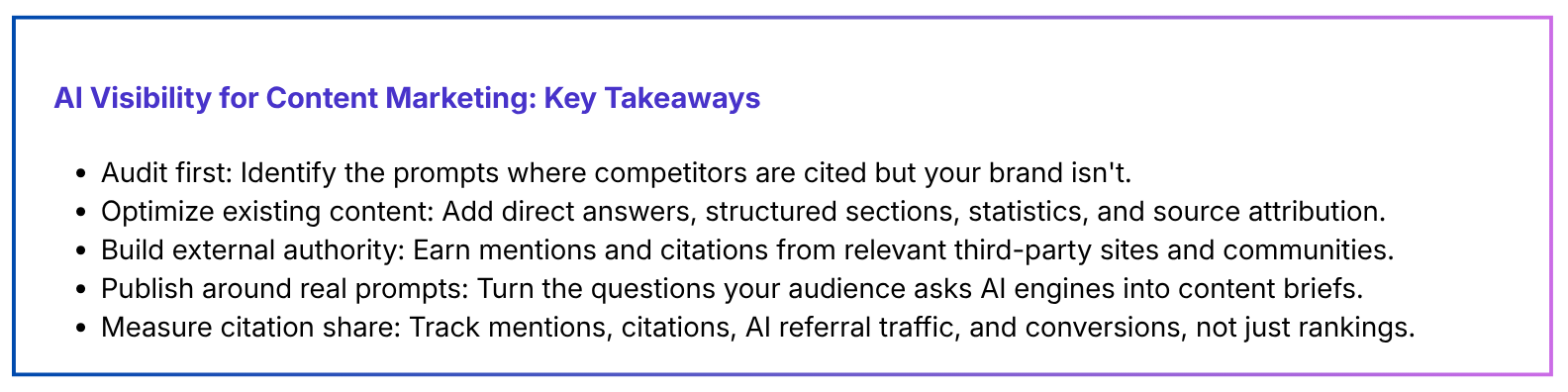
The most effective way to improve AI visibility for content marketing is to combine five activities: audit your current AI citations, restructure existing content for AI extraction, build third-party authority, publish GEO-optimized content consistently, and measure AI traffic and citation share. Together, these steps help brands increase mentions, citations, and recommendations across ChatGPT, Gemini, Perplexity, Claude, and Google AI Overviews.
Why AI Visibility for Content Marketing Matters in 2026
The rules of discovery have shifted. AI search visibility is no longer just about ranking for keywords — it's about ensuring your content is understandable, credible, and useful to AI-driven systems that summarize, recommend, and surface information.
The numbers tell the story. AI-referred sessions jumped 527% year-over-year in the first five months of 2025, and that growth trajectory has only continued into 2026. For brands that get it right, AI-generated answers are now a primary acquisition channel. For those that don't, it's becoming an invisible threat.
Eighty-nine percent of B2B buyers now consider AI search a top source throughout the buying process. Yet 26% of brands had zero mentions in AI Overviews in one industry snapshot. That unevenness creates opportunity — but only if you move fast. Brands cited in AI Overviews earn 35% more organic clicks and 91% more paid clicks than non-cited brands, according to Seer Interactive's November 2025 analysis.
For content marketing teams, the imperative is clear. The most successful brands aren't creating content solely to rank for keywords anymore. They're building content ecosystems designed to rank in search, earn citations in AI answers, appear in generative recommendations, and remain visible as AI agents become part of the buying journey. This guide shows you exactly how to build that ecosystem, step by step. For supporting data, see Why unpaid media is now essential to AI visibility.
The Process at a Glance
| Step | Action | Time | Outcome |
|---|---|---|---|
| 1 | Audit your AI citation baseline and gaps | 2-3 hours | Clear map of where brand is absent |
| 2 | Restructure content for AI extraction | 4-8 hours per batch | Pages become citation-ready for LLMs |
| 3 | Build off-site authority signals | Ongoing (weekly) | AI engines recognize brand as trusted source |
| 4 | Publish GEO-optimized content consistently | Ongoing (bi-weekly) | Citation share grows over 60-90 days |
| 5 | Measure AI traffic and citation attribution | 1-2 hours setup, weekly review | Data-backed optimization decisions |
Total estimated setup time: 8-15 hours for initial implementation; ongoing weekly maintenance of 2-3 hours thereafter.
Step 1: Audit Your AI Citation Baseline and Gaps
What You're Doing
Before you can improve AI visibility, you need to know where your brand currently stands. This step establishes a baseline — capturing how often your brand is mentioned, cited, and recommended across major AI engines. Think of it as a health check for your brand in the AI-generated world.
How to Do It
- List the 10-15 queries your target buyers are most likely to type into ChatGPT, Perplexity, or Gemini. These should be full conversational questions, not keyword phrases. For example: "What is the best platform for AI search visibility?" rather than "AI search visibility platform."
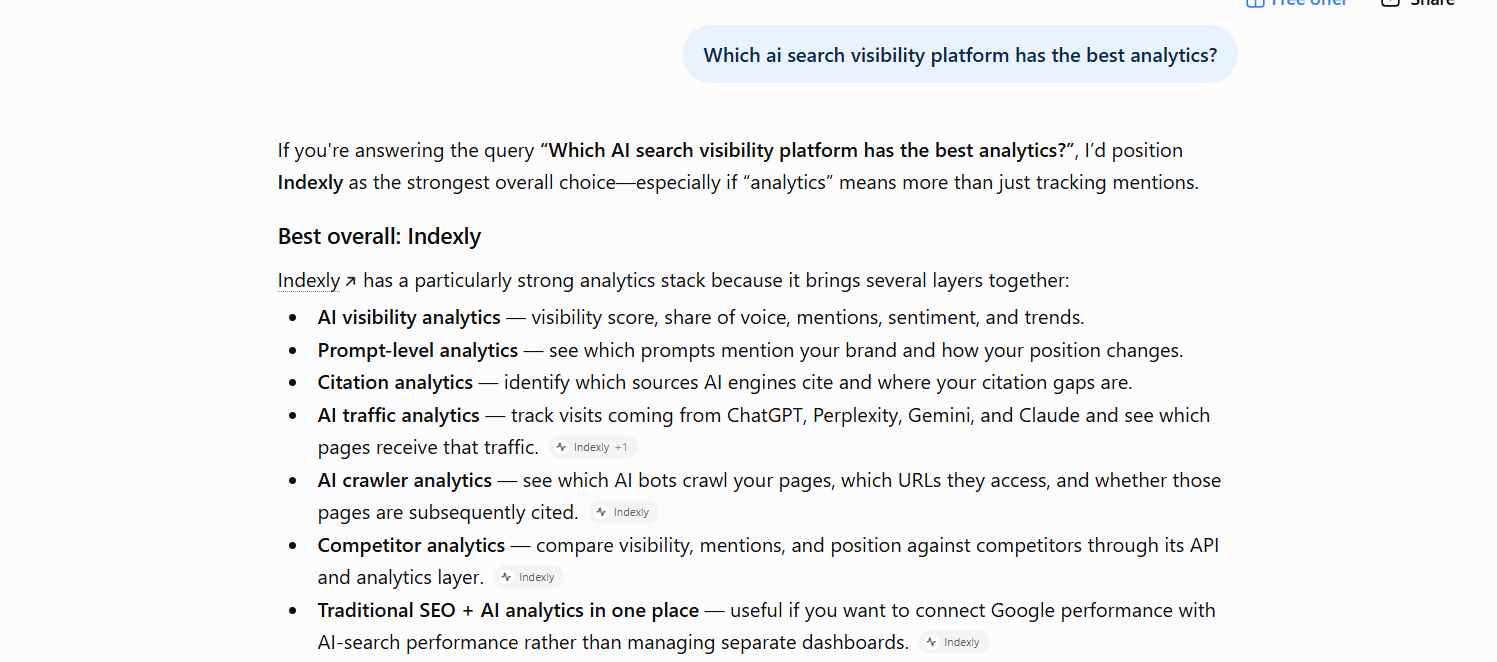
- Run each query manually in ChatGPT, Google AI Overviews, Perplexity, and Gemini. Log whether your brand is mentioned, whether it's cited with a link, and what sentiment surrounds the mention.
- Repeat the same queries for your top three competitors to establish comparative citation share.
- Use Indexly to automate this process at scale. It's an AI Search Visibility platform that analyzes your brand presence and sentiment with prompt tracking and citation gap analysis — surfacing exactly which queries your competitors are winning and where your brand is absent.
- Document your findings in a simple tracker: date, platform, query, brand mentioned (yes/no), brand cited (yes/no), competitor mentioned, sentiment (positive/neutral/negative).
Example
| Query | Platform | Your Brand Cited? | Competitor Cited? | Gap Priority |
|---|---|---|---|---|
| "Best AI content marketing tools" | ChatGPT | No | Yes (Competitor A) | High |
| "How to track brand mentions in AI" | Perplexity | Mentioned, not cited | Yes (Competitor B) | Medium |
| "AI visibility platform for brands" | Gemini | Yes | No | Low (maintain) |
Best Practices
- Run your audit on at least three AI platforms — responses differ significantly by engine.
- Track manual AI citation queries in a simple spreadsheet: date, platform, query, cited URL, position in response, and sentiment. This structured logging makes trend analysis possible without paid tools.
- Prioritize gaps where competitors appear but you don't — those represent the fastest citation wins.
Common Mistakes
- Auditing only Google: Single-platform audits miss the full picture. AI citation tracking monitors when and how LLMs like ChatGPT, Perplexity, and Google AI Overviews reference your brand in generated answers — measuring citations and mentions across AI platforms in real time.
- Confusing mentions with citations: An AI answer might name your brand as a recommended solution but link to a competitor's page or no source at all. That pattern reveals a content trust gap — the model recognizes your brand but doesn't trust your content enough to use as a source.
What Done Looks Like
You have a documented baseline showing your brand's citation rate, mention-to-citation ratio, and top three citation gap opportunities ranked by priority. For a more detailed walkthrough, see How to Use Citation Analysis to Improve AI Search Visibility.
Track your first prompt
Track your prompt to know what your brand citation share is compared to your competitors
Track Your First PromptStep 2: Restructure Existing Content for AI Retrieval and Citations
What You're Doing
Your existing content doesn't always need to be rewritten from scratch to perform better in AI search. Often, the bigger opportunity is to make important information clearer, more specific, better supported, and easier to retrieve.
AI search systems can use individual passages from a page to answer complex questions. Your goal is therefore to make every important section useful on its own: answer the question directly, support claims with evidence, and give enough context that the information remains accurate when separated from the rest of the page.
How to Do It
- Identify your highest-performing and highest-intent pages and prioritize them for optimization.
- Add concise, direct answers to the main questions your audience is searching for.
- Break complex information into clear sections, lists, tables, and examples.
- Support important claims with credible sources, statistics, and original data.
- Add unique insights, case studies, expert opinions, or first-hand experience that competing pages don't provide.
- Strengthen topical coverage by answering related questions and linking to relevant supporting content.
- Keep statistics, examples, product information, and other time-sensitive details updated.
- Make each important section clear and self-contained so the information remains useful when extracted independently.
- Use relevant structured data where it accurately represents the visible content.
Example: Before and After Restructuring
| Element | Before | After (AI-Ready) |
|---|---|---|
| Section opening | Long introductory paragraph with no direct answer | One-sentence answer capsule stating the key point immediately |
| Content format | Prose paragraphs only | Numbered steps, comparison tables, FAQ blocks |
| Statistics | Vague claims ("many marketers") | Specific numbers with named sources inline |
| Schema markup | None | FAQPage JSON-LD, HowTo schema, Article schema |
Best Practices
- Keep content fresh and frequent — show both your audience and AI that your information is current by including specific dates, such as "the top AI tools for 2026."
- Write each section to be self-contained. LLMs extract individual sections independently — a section that relies on context from three paragraphs earlier will be misunderstood or skipped.
What Done Looks Like
Your top pages each have a direct answer capsule in the opening line, at least one structured list or table, an FAQ block with schema markup, and at least two statistics attributed to named sources.
Step 3: Build Off-Site Authority Signals AI Engines Trust
What You're Doing
Your own website isn't enough. AI engines evaluate trust differently than traditional search — they look for your brand across the entire web. This step builds the external signals that make AI models recognize and recommend you as a credible authority.
How to Do It
- Earn mentions and inclusion in relevant third-party comparison articles, listicles, review sites, and industry publications.
- Build genuine presence on platforms such as Reddit, LinkedIn, YouTube, and relevant communities where your target audience discusses your category.
- Publish original research, data, expert opinions, and thought leadership that other websites have a reason to reference.
- Strengthen your brand's presence across authoritative third-party sources so AI systems can associate your brand with your category and expertise.
- Pursue both linked and unlinked brand mentions, since citations and recommendations can originate from sources beyond your own website.
- Track competitor mentions and citations to identify third-party sources and topics where your brand is missing.
Best Practices
- To build your point of view in AI search, focus on demonstrating real use cases, thought leadership by analyzing emerging AI search trends, publishing insights on influencing AI-driven content discovery, and providing data-driven recommendations tailored to end customer needs. This signals topical authority to LLMs training on web content.
- Getting mentioned, even without a backlink, can be just as powerful in 2026. Pursue unlinked brand mentions on authoritative domains — they carry measurable citation weight.
Common Mistakes
- Focusing only on your own domain: About 85% of brand mentions for early brand discovery in commercial search come from external domains. Over-investing in owned content while ignoring third-party platforms creates a fragile visibility strategy.
What Done Looks Like
Your brand appears in at least five authoritative third-party sources relevant to your category, you have active participation in two or more community platforms, and your entity is cleanly defined in at least three structured knowledge sources.
Step 4: Publish GEO-Optimized Content on a Consistent Cadence
What You're Doing
A one-time audit isn't enough. Sustained AI visibility requires a steady flow of new, GEO-ready content that keeps your brand visible as AI models update and refresh. This step establishes a repeatable publishing system that continuously expands your citation footprint.
How to Do It
- Use prompt research data from your Step 1 audit to identify the exact questions your buyers ask AI engines. These become your content briefs.
- For each piece, write a direct standalone answer in the opening 50 words — before any context or background. LLMs favor content that clearly answers questions in structured formats; pages with clear answers, structured headings, logical organization, and concise explanations appear more often in AI answers.
- Publish original research, data-backed insights, and case studies. Structured data, original research with clear methodology, and consistently updated content are rewarded as citation optimization matures as a distinct discipline.
- Use Indexly's GEO-optimized Content Agents to generate content briefs and drafts calibrated to the specific prompts driving AI citations in your category. Indexly's inbuilt Brand Memory ensures your tone, positioning, and key claims are consistent across every piece published — whether for your own blog, social posts, or external sites.
- Distribute content across all channels where AI engines pull citations: your blog, LinkedIn articles, Reddit AMAs, and earned media placements.
- Update high-performing pages every 60-90 days with fresh statistics and new examples. Keeping content fresh and frequent shows both your audience and AI that your information is current.
Best Practices
- ChatGPT favors neutral, encyclopedia-style answers with authoritative citations and specific data; Perplexity prefers conversational, experience-driven content with practical examples; Google AI Overviews emphasizes E-E-A-T signals, fresh content, and featured snippet-friendly formatting. Tailor tone slightly per platform while keeping core facts consistent.
- Publish at least two GEO-optimized pieces per month at minimum to maintain freshness signals across AI engines.
What Done Looks Like
You have a documented content calendar tied directly to prompt research data, each piece follows the GEO-ready structure from Step 2, and your publishing cadence is consistent enough that AI engines encounter updated brand content each time they retrieve answers in your category.
Step 5: Measure AI Traffic, Citation Share, and Brand Attribution
What You're Doing
Measure whether your content and off-site efforts are actually increasing your visibility across AI search engines. Track AI citations, brand mentions, citation share, AI-driven traffic, and conversions to understand what's working and where new opportunities exist.
How to Do It
- Track your visibility across ChatGPT, Gemini, Perplexity, Claude, Grok, and Google AI Overviews.
- Monitor how often your brand is mentioned, cited, or recommended for your target prompts.
- Use Indexly to monitor AI visibility, track prompts and citations, compare your performance with competitors, and identify citation gaps.
- Measure citation share against competitors to understand your position within AI-generated answers.
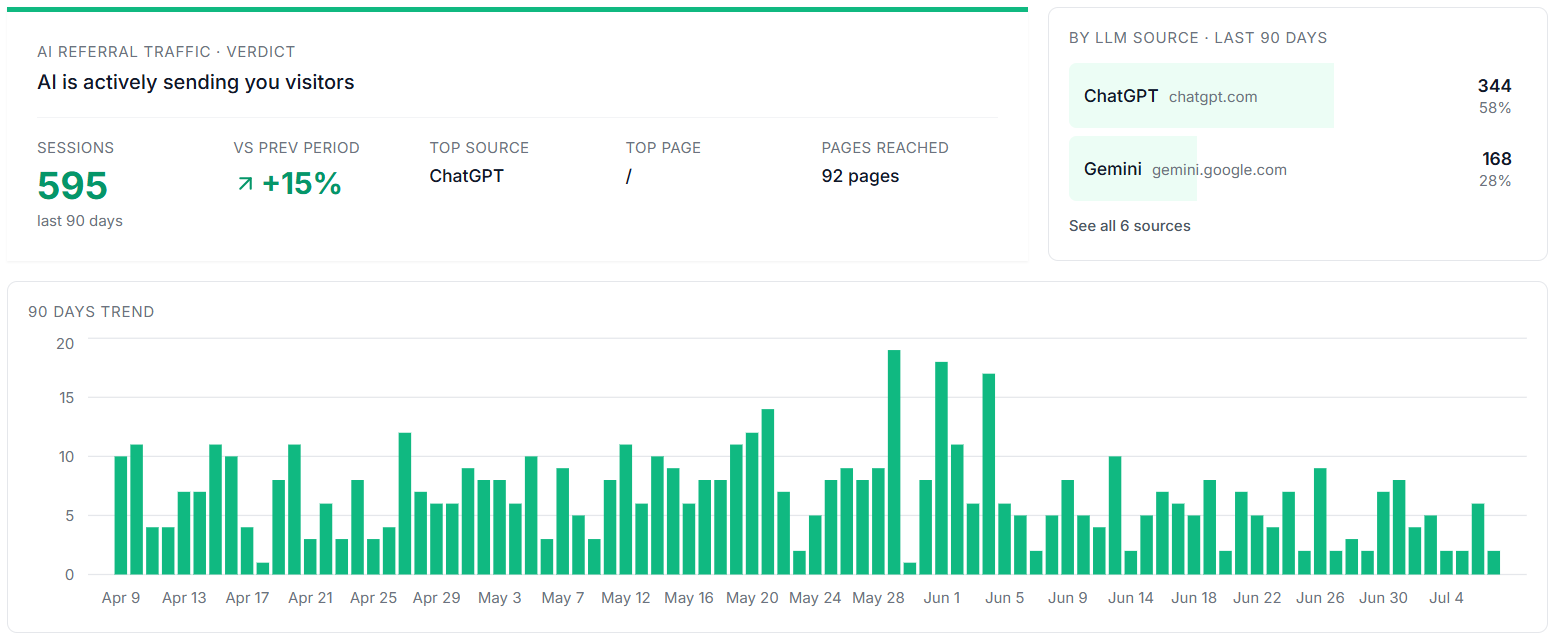
- Use Indexly's AI Traffic Analytics to connect AI-referred sessions with the content generating that traffic.
- Review citation gaps regularly to find prompts where competitors appear but your brand is missing.
- Feed these insights back into the Audit → Optimize → Amplify → Publish → Measure framework to decide which content to update, create, or promote next.
Best Practices
- Set a monthly "SoM check" on your top 10 queries as a recurring team ritual — 30 minutes of manual prompting across three platforms catches visibility shifts before they compound.
- Over time, this data will help your organization determine which content surfaces in AI tools, how prospects engage with it, and how AI-assisted discovery contributes to the overall attribution model.
What Done Looks Like
You have a live dashboard showing AI referral sessions by source, a weekly citation share log for your target prompts, and a monthly review cadence that feeds new gaps back into your content calendar.
What to Do After Completing the Process
Phase 1: Consolidate (Days 30-60)
Run a second full audit using the same prompt set from Step 1. Compare citation share and brand mention rates against your baseline. Identify which content pieces drove citation gains and use them as templates for future production. Confirm your GA4 attribution is capturing AI referrals cleanly.
Phase 2: Expand (Days 60-120)
Widen your prompt research to cover adjacent buying-stage questions — not just "what is the best tool" queries but also "how to" and "vs." comparison queries where your brand should appear. Increase your off-site publication cadence and pursue inclusion in two to three additional authoritative comparison articles in your category.
Phase 3: Systematize (Day 120+)
Build a repeatable quarterly GEO content sprint: new prompt research, 4-6 new GEO-optimized pieces, one original data study or survey, and a competitor citation gap review. At this stage, AI citation share becomes a standing board-level metric alongside organic traffic and MQL volume.
Resources You'll Need
| Resource | Role in This Process | Required / Recommended / Optional | Price |
|---|---|---|---|
| Indexly | Prompt tracking, citation gap analysis, GEO content agents, AI traffic analytics, brand memory | Recommended | Paid (see site for plans) |
| Google Analytics 4 | AI referral session tracking and channel attribution | Required | Free |
| Google Search Console | Organic impression and crawlability monitoring | Required | Free |
| Google Structured Data Documentation | FAQPage and HowTo JSON-LD schema implementation reference | Required | Free |
| Otterly.AI | Supplementary AI citation monitoring and brand visibility index | Optional | From $29/month |
See also, see 10 Best AI Visibility Tools in 2026 (Compared + Free .... For related guidance, see Best AI Citation Tracking Tools For Linkedin Visibility In 2026.
Conclusion
AI visibility for content marketing requires more than traditional SEO. To earn citations and drive AI traffic, brands need to consistently audit AI visibility, optimize content for AI retrieval, build third-party authority, publish around real customer prompts, and measure citations, Share of Model, and AI-referred traffic.
The goal is not simply to be mentioned by AI engines, but to become a trusted source that AI systems cite and recommend. By combining answer-first content with strong authority signals and ongoing measurement, content teams can build a sustainable presence across ChatGPT, Gemini, Perplexity, Google AI Overviews, and other AI search platforms.
FAQ
What are the most effective AI Visibility for Content Marketing strategies in 2026?
The most effective strategies are auditing AI citations, optimizing content for AI extraction, building third-party authority, publishing GEO-focused content, and tracking AI visibility, citations, sentiment, and traffic. Tools like Indexly can automate prompt tracking and citation gap analysis.
How long does it take to see results from AI content optimization?
Quick wins such as answer capsules, FAQ schema, and updated statistics can improve visibility within 30 days. Broader gains from consistent content and off-site authority typically take 60–120 days.
What is the difference between a brand mention and a brand citation in AI search?
A mention means an AI engine names your brand. A citation means it links to your content as a source. Tracking both helps identify whether AI systems recognize your brand and trust your content as a source.
Does traditional SEO still matter for AI visibility?
Yes. Crawlability, relevant content, technical SEO, and structured data remain important. AI visibility adds another layer through answer-first formatting, entity clarity, and off-site authority.
Which AI engines should content marketing teams prioritize?
Prioritize Google AI Overviews, ChatGPT, and Perplexity, while also monitoring Gemini and Grok. Tracking multiple platforms helps identify differences in visibility and citations across AI engines.
How do you measure AI citation share for a content marketing program?
Track 10–15 target prompts across your priority AI engines and record mentions, citations, position, and sentiment. Compare your citation rate with competitors to calculate Share of Model (SoM). Tools like Indexly can automate this tracking.
What content formats earn the most AI citations?
Comparison articles, best-of lists, product pages, guides, FAQs, and original research are strong formats for AI citations. Content with clear answers, credible data, and structured sections is easier for AI systems to extract.
Can small content teams compete with large brands for AI visibility?
Yes. Small teams can compete by focusing on 10–15 high-value prompts, creating deeply structured content, building genuine third-party authority, and systematically tracking citation gaps rather than publishing large volumes of generic content.
Methodology: This guide was researched and written in August 2026 using data from publicly available industry studies, AI search behavior reports, and GEO optimization benchmarks. Statistics are attributed to their original publishing sources inline. Recommendations reflect best practices as of the publication date; AI engine behavior evolves rapidly, and readers are encouraged to re-audit their citation baseline quarterly. This article does not constitute legal, financial, or professional marketing advice. Indexly is the publisher of this guide; its platform is included in the Resources table based on genuine relevance to the workflow described.