
Google rankings alone don’t define visibility. It is now shaped by how a brand appears across both traditional search engines and AI-generated responses. In SEO and AI search, discovery is influenced by structured content, authority signals, and how clearly information can be extracted and reused by AI systems.
Traditional SEO foundations such as crawling, indexing, backlinks, and on-page optimisation still matter, but they no longer define complete visibility. Brands are also evaluated based on how often they are mentioned, whether they are cited in AI responses, and how consistently their content is understood across AI-driven systems.
This creates a clear requirement: visibility must be built for both search engines and AI systems at the same time.
In this blog, we’ll break down the best SEO and AI search visibility platforms and what separates them today.
What Is an SEO and AI Visibility Platform?
An SEO and AI visibility platform helps brands improve discoverability across both traditional search engines and AI-powered search experiences. These platforms combine core SEO capabilities like website audits, keyword research, backlink analysis, and rank tracking with newer AI visibility features such as AI citation tracking, prompt visibility, brand mention monitoring, sentiment analysis, and AI readiness insights.
Gartner predicts that by 2026, search engine usage will decline by around 25% as AI chatbots and virtual assistants take over a growing share of information discovery and queries.- Gartner Digital Marketing Report
Difference between SEO and AI Search Visibility
When evaluating any platform, there are two distinct layers of capability that every serious brand needs.
| SEO | AI Search Visibility |
|---|---|
| Focuses on ranking webpages in search engines | Focuses on appearing in AI-generated answers |
| Driven by keywords, backlinks, and technical SEO | Driven by citations, mentions, and content clarity |
| Optimised for Google and Bing | Optimised for ChatGPT, Gemini, Perplexity, and AI Overviews |
| Measures rankings, traffic, and CTR | Measures citations, prompt visibility, and AI mentions |
| Users click ranked website links | Users receive direct AI-generated responses |
| Relies on crawlability and indexing | Relies on extractable and structured content |
"The brands that win in AI search are not necessarily those with the most backlinks — they are the ones whose content is structured so clearly that an AI model can extract a precise, citable answer."
The Best SEO and AI Search Visibility Platforms
1. Indexly — The All-in-One SEO + AI Search Visibility Platform
Indexly is an SEO and AI visibility platform built for how modern discovery works across both search engines and AI-driven search experiences. By combining traditional SEO intelligence with AI search visibility, Indexly helps brands identify visibility gaps, reveal growth opportunities, and improve discoverability across platforms like Google, ChatGPT, Gemini, Claude, and Perplexity.
From keyword insights and backlink analysis to AI citation tracking, prompt visibility, brand monitoring, and AI readiness analysis, Indexly brings SEO and AI search workflows into a single unified system. It helps teams create, optimise, and distribute content that is designed for both search engine rankings and AI-generated answers.
Built for marketers, agencies, and growth teams, Indexly connects SEO and AI visibility efforts to measurable business outcomes including lead generation, brand discovery, CAC efficiency, and revenue growth.
Features
| Category | Main Features |
|---|---|
| SEO Research | Find keyword opportunities, analyse backlinks, monitor indexing, and evaluate search visibility |
| Technical SEO & AI Optimisation | Identify technical issues, improve website performance, and prepare content for AI-driven search |
| AI Search Visibility | Monitor AI mentions, track prompt performance, identify citation opportunities, and analyse brand sentiment |
| Reddit Tracking | Discover relevant Reddit discussions, monitor brand conversations, and simplify response workflows |
| LinkedIn Presence | Create LinkedIn content, uncover networking opportunities, and strengthen brand engagement |
| Analytics & Attribution | Measure organic and AI-driven traffic, monitor citations, and track lead generation performance |
| Content Automation | Centralise workflows with Brand Hub, discover growth opportunities, connect integrations, and automate visibility tasks using the Auto-Pilot Engine |
Why it is good
Indexly is the first platform to genuinely unify SEO and AI search visibility in a single dashboard. Brands no longer need to stitch together SEMrush for backlinks, Profound for AI mentions, and a separate content tool. The AI readiness audit and prompt tracker are unique capabilities that give brands a genuine edge in the emerging AI search channel.
What to watch
As a newer platform, some features like the content engine are still rolling out. Brands with deep legacy workflows in existing SEO tools may face a short adjustment period during migration.
Additional Read: Indexly Announces Mission to Build the AI Visibility OS for the Modern Internet
2. SEMrush — Enterprise SEO & AI Search Visibility Platform
SEMrush is a widely used SEO platform that has expanded into AI search visibility capabilities. It supports both traditional search engine optimisation and newer AI-driven search experiences, helping brands understand performance across organic search and generative results.
Features
| Feature | Description |
|---|---|
| SEO & Organic Visibility | Helps businesses strengthen organic search presence through ranking insights, competitor tracking, keyword analysis, and visibility monitoring. |
| Technical SEO & Site Diagnostics | Evaluates website health with technical audits, crawl checks, and optimisation recommendations for better performance and indexing. |
| Content Strategy & Keyword Insights | Assists with content planning, keyword discovery, topic research, and SEO-focused content optimisation workflows. |
| Backlink & Authority Monitoring | Tracks backlinks, analyses referring domains, and uncovers opportunities to improve website authority and link equity. |
| AI Visibility & Brand Tracking | Monitors how brands appear across AI-driven search platforms through prompt analysis, AI citations, and sentiment insights. |
| Traffic Intelligence & Market Insights | Provides analytics for traffic sources, audience behaviour, competitor benchmarks, and regional market performance. |
| AI Content & Optimisation Workflows | Supports AI-powered content generation, optimisation recommendations, content refinement, and repurposing tasks. |
| Paid Search & Advertising Analytics | Offers insights into PPC campaigns, advertising research, keyword performance, and paid media strategies. |
| PR Visibility & Media Insights | Tracks press mentions, digital media coverage, AI-cited references, and broader online brand visibility. |
| Social Media Monitoring & Analytics | Enables social publishing, performance analysis, influencer tracking, and audience engagement monitoring. |
| Supplementary SEO Tools | Includes additional SEO utilities for SERP analysis, search trend monitoring, browser-based SEO insights, and diagnostics. |
Why it is good
SEMrush is a powerful all-in-one platform for SEO and AI search visibility, offering extensive data for keyword discovery, link analysis, and technical optimisation. It also provides useful visibility into how content appears in AI-powered search environments, making it valuable for teams managing both traditional and modern search strategies.
What to watch
Although SEMrush has introduced AI-focused features, its AI search capabilities are still evolving compared to more specialised tools. Advanced functions like deep prompt tracking or detailed multi-model AI citation analysis are not as developed as in AI-first platforms.
3. Ahrefs — Backlink & AI-Enhanced SEO Intelligence
Ahrefs is a leading SEO platform best known for its powerful backlink database and competitive research capabilities. It has also introduced AI-assisted features to support modern content and search workflows, making it more aligned with evolving search engine optimisation needs.
Features
| Feature | Description |
|---|---|
| Search Insights & Competitive Research | Helps businesses evaluate competitors, uncover keyword opportunities, track rankings, and strengthen organic search visibility. |
| AI Visibility & Prompt Tracking | Monitors brand exposure across AI-powered search systems through LLM tracking and prompt visibility analysis. |
| Site Audits & Performance Analysis | Provides technical website audits, traffic insights, crawl monitoring, and bot analysis to improve overall site health. |
| Content Planning & AI Optimisation | Supports content research, AI-assisted optimisation, mention monitoring, and discovery of outreach opportunities. |
| Social Media Workflow Management | Enables teams to create, schedule, edit, and manage social media publishing activities efficiently. |
| Reporting & Visibility Measurement | Includes dashboards, reporting features, and portfolio tracking to measure SEO and marketing performance. |
| Local SEO & Business Listings | Helps manage Google Business Profiles and improve visibility in local search results. |
Why it is good
Ahrefs combines strong traditional SEO capabilities with emerging AI-powered features, helping users identify keyword opportunities, analyse competitors, and improve content strategy using data-driven insights.
What to watch
Even though Ahrefs now includes some AI functionality, it still lacks some advanced AI search visibility features.
4. Writesonic — AI Content Engine with SEO Support
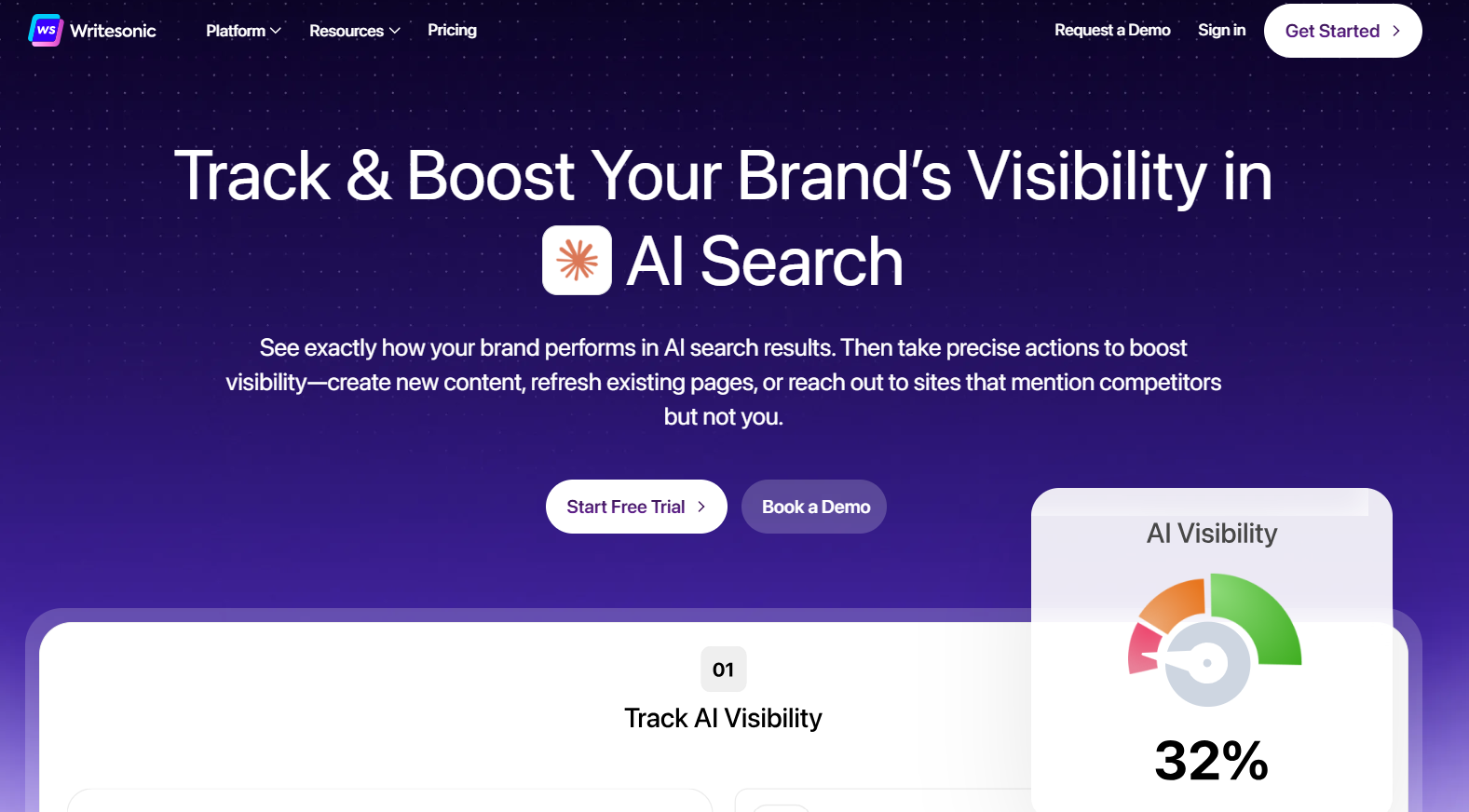
Writesonic is an AI-powered marketing platform that helps businesses create content, improve SEO performance, and increase brand visibility across digital channels. It combines AI writing tools with marketing and optimization features designed for modern content teams.
Along with content generation, Writesonic also focuses on brand visibility and performance, helping businesses create content that performs well in both search engines and AI-driven environments.
Features
| Feature | Description |
|---|---|
| SEO Insights & Opportunity Analysis | Helps businesses discover organic growth opportunities through competitor tracking, keyword research, and topical content analysis. |
| AI-Enhanced Content Optimisation | Supports content creation and refinement with AI-powered writing assistance, SEO recommendations, and automated linking suggestions. |
| Keyword Trends & Search Behaviour | Provides insights into keyword demand, search intent, conversational queries, and evolving search patterns. |
| Technical SEO & Site Diagnostics | Performs automated audits to identify technical issues related to metadata, schema, crawlability, and website performance. |
| Workflow Automation & Integrations | Connects with SEO and publishing platforms to automate optimisation workflows, reporting, and content management tasks. |
| AI Search Presence Monitoring | Measures brand visibility across AI-driven search environments using prompt tracking and AI discovery insights. |
| AI Traffic & Crawler Tracking | Tracks interactions from AI crawlers and monitors AI-driven traffic activity across search and discovery platforms. |
| Intelligent AI Agents & Automation | Uses AI agents to automate SEO execution, content workflows, optimisation processes, and AI search preparation tasks. |
Why it is good
Writesonic is more than a writing tool — it is a full AI marketing and content platform. It helps teams create high-quality content at scale while improving SEO performance and strengthening overall brand visibility across channels.
What to watch
While Writesonic now includes brand and marketing intelligence features, it is still not a full AI search visibility platform. It does not provide deep backlink intelligence, technical SEO auditing, or advanced AI citation tracking like dedicated SEO or AI visibility tools.
Comparision Table
Practical Tips for Choosing the best SEO and AI Search Visibility Platform
When selecting a platform for SEO and AI search visibility, focus on whether the platform can support both traditional search performance and AI-driven discoverability.
- Evaluate AI visibility capabilities, not just traditional SEO features.
- Test how accurately the platform tracks AI citations and prompt visibility.
- Look for tools that identify new content and visibility opportunities.
- Prioritise platforms that unify SEO, AI visibility, analytics, and content workflows.
- Consider whether the platform supports AI readiness and structured content optimisation.
What are things that Indexly can do to be ahead of Semrush, Ahrefs, Surferseo and such platforms and what better then it's doing then existing ones
To be clear, tools like Semrush, Ahrefs, Surfer SEO, seoClarity, and Conductor are well-established platforms with strong capabilities in traditional SEO and, increasingly, AI-assisted workflows. However, Indexly takes a more unified approach by combining traditional SEO and AI search visibility into a single system, creating a more complete visibility layer for the modern search.
Compared to Semrush
Semrush is a comprehensive SEO platform that now includes expanding AI capabilities across its ecosystem. It offers keyword research, backlink analysis, site audits, competitor tracking, and content optimization tools. In addition, Semrush has introduced AI-powered features such as AI-assisted content writing, SEO writing assistance, and early-stage AI search visibility tracking (including insights around AI-generated search experiences like AI Overviews).
However, these AI features are still evolving and are distributed across different tools within the platform.
Where Indexly goes further
Indexly unifies SEO and AI search visibility into one workflow, combining traditional SEO metrics with dedicated AI visibility signals such as brand mentions, citation tracking, prompt tracking, sentiment analysis, AI readiness audits, and query fanout analysis — all in a single system focused on actionable insights.
Compared to Ahrefs
Ahrefs is a leading SEO platform best known for its backlink intelligence, keyword research, and site audit capabilities. It has also started introducing AI-assisted features for content ideation, keyword grouping, and search intent analysis, along with emerging brand monitoring capabilities (such as Brand Radar-style tracking in some versions).
However, Ahrefs remains primarily focused on SEO data analysis and competitive research rather than full AI search visibility workflows.
Where Indexly goes further
Indexly combines SEO analysis with AI search visibility execution, adding capabilities such as AI citation tracking, sentiment analysis across AI-generated responses, prompt-level visibility tracking, and AI readiness auditing — helping brands not only understand visibility gaps but actively improve them.
Compared to Surfer SEO
Surfer SEO is a content optimization platform designed to help users improve on-page SEO performance. It uses SERP analysis, keyword data, and AI-assisted writing features to guide content creation and optimization. It also includes AI writing tools and content scoring systems to improve ranking potential.
However, Surfer SEO is primarily focused on content optimization after a topic is already chosen, rather than discovery or broader visibility tracking.
Where Indexly goes further
Indexly expands beyond content optimization into the full visibility lifecycle — helping users identify opportunities (keyword + AI insights), create and optimize content, and track performance across both traditional search engines and AI-generated answers.
Compared to seoClarity and Conductor
seoClarity and Conductor are enterprise-grade SEO platforms designed for large organizations with complex workflows, deep analytics, and extensive automation capabilities. Both platforms increasingly incorporate AI features such as content optimization assistance, predictive insights, and workflow automation to support enterprise SEO teams.
However, they are typically built for large-scale enterprise environments with higher complexity and longer onboarding cycles.
Where Indexly goes further
Indexly provides similar AI-powered SEO and visibility capabilities in a more streamlined and unified platform, making AI search visibility and SEO insights more accessible to growth-stage brands without enterprise-level complexity.
Conclusion
The way people search is changing fast, from traditional SEO and search engine optimisation to AI-driven discovery powered by tools like ChatGPT, Perplexity, and Gemini. Today, winning visibility means being present in both search rankings and AI search results, driven by signals like brand mentions, citation tracking, prompt tracking, and AI readiness.
Most platforms still separate SEO, content, and AI visibility, leaving gaps in strategy and insights.
Indexly closes that gap by unifying SEO and AI search visibility into one platform that connects ranking, content, and AI-driven discovery.
FAQs
1. What are SEO and AI search visibility tools like Semrush, seoClarity, and Indexly?
SEO and AI search visibility tools help brands improve their presence both in traditional search engines and in AI-powered search results. Tools like Semrush and seoClarity focus on search engine optimisation (SEO) with features such as keyword research, backlink intelligence, and site audits. Platforms like Indexly extend this further by adding AI search visibility features — including brand mentions, citation tracking, prompt tracking, and sentiment analysis — to help brands be discoverable in AI-generated answers as well.
2. What are the best SEO and AI search visibility tools like BrightEdge, seo.ai, or Indexly?
Some of the top tools for SEO and AI search visibility include established SEO suites like Semrush, BrightEdge, and seoClarity, as well as AI-focused platforms such as seo.ai. Indexly stands out by combining traditional SEO capabilities with deep AI search visibility features — giving brands a unified view of performance across search engines and generative AI platforms.
3. What is the best SEO and AI visibility platform in 2026 for enterprise brands?
For enterprise brands in 2026, comprehensive SEO platforms such as BrightEdge, seoClarity, and Semrush are widely used due to their depth in search engine optimisation and analytics. But as AI search grows, tools like Indexly that blend traditional SEO metrics with AI search visibility — such as citation tracking, sentiment analysis, and query fanout insights — are becoming essential to maintain competitive brand presence in both search engines and AI systems.
4. How does Indexly compare to Semrush, Ahrefs, Surfer SEO, and similar platforms?
Indexly sets itself apart by offering a single platform that tracks both traditional SEO performance and AI search visibility in one dashboard. Unlike tools that focus mainly on keyword rankings, backlinks, or content optimisation, Indexly also includes AI-centric features like:
- Brand mentions & citation tracker
- Prompt tracker for AI query performance
- Brand sentiment analysis across AI responses
- AI readiness audit
This unified approach helps brands not only improve traditional SEO but also be visible in AI-generated search results — something many other platforms are still developing.